The claim
The American system corrected itself, and it did not need a crisis to do it
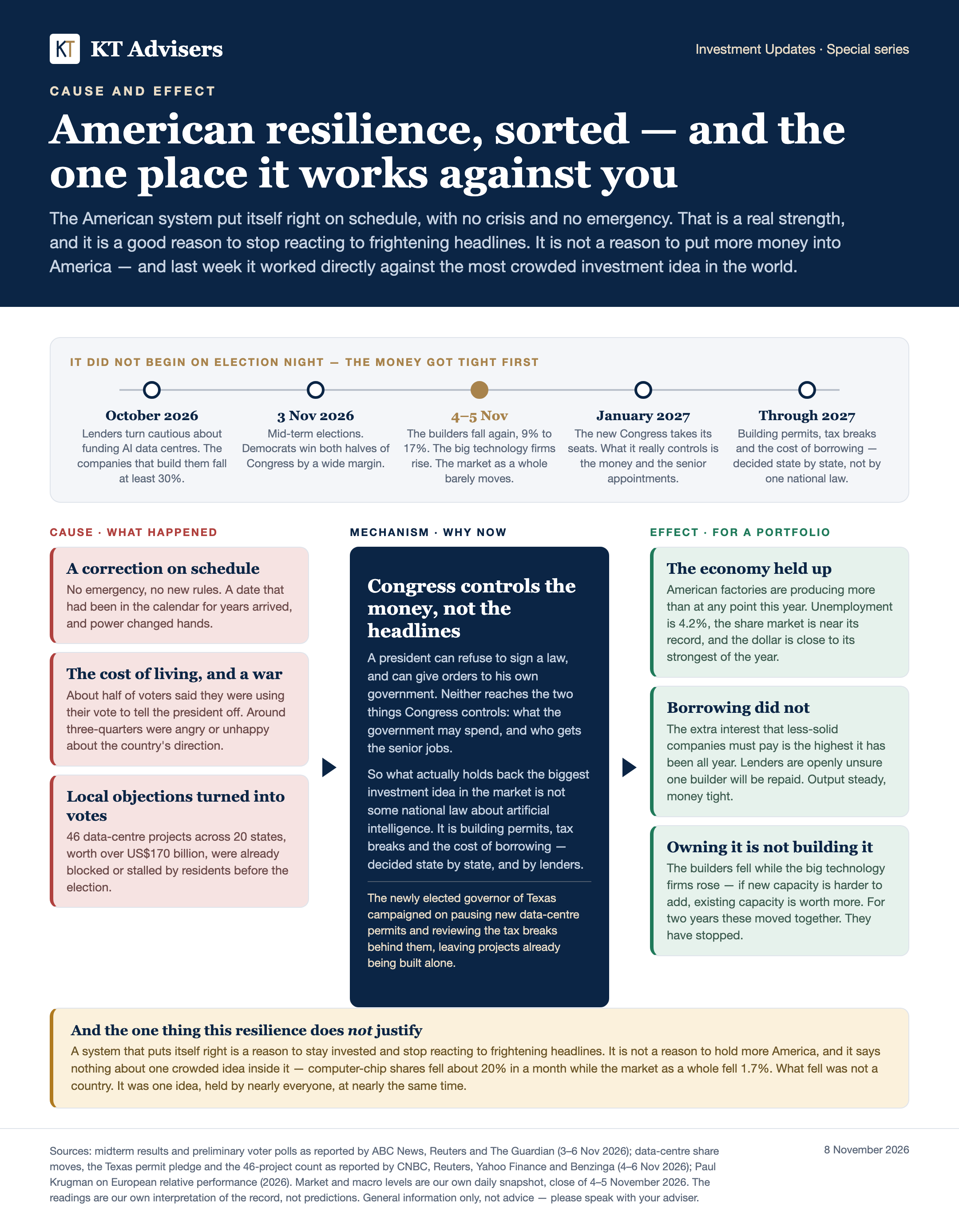
On 3 November, American voters gave both halves of Congress to the Democrats. The counting was not quite finished when we wrote this, but the picture was clear: roughly 225 seats in the House of Representatives, and 54 in the Senate. Vice-President Vance did not wait to be asked why his party lost. He named the war with Iran.
Polls taken as people left the voting booths told the same story. About half of voters said they were using their vote to tell the president off. Around three-quarters said they were angry or unhappy about the direction the country is going in.
Now, the result itself is not what interests us. What interests us is how it happened. There was no emergency. Nobody had to invent a new rule, or step outside the system, or appeal to anybody's better nature. A date that had been in the calendar for years simply arrived, people voted, and the balance of power in Washington changed.
And the power the president keeps for his last two years is thinner than it sounds. He can veto a law — that is, refuse to sign it, so it does not happen. He can sign executive orders, which are instructions he gives to his own government without asking Congress. But neither of those reaches the two things Congress controls: the money, and the appointments. Congress decides what the government is allowed to spend, and the Senate decides who gets confirmed into senior jobs. A president cannot veto his way around either of those.
That — a system that puts itself right on a schedule everybody knows in advance — is what people mean, or ought to mean, when they say America is resilient. It is worth carefully separating from two or three other things that get called by the same name.
The distinction
Four things get called "American resilience". Two are real, one is under strain, and one is just a story
This matters more than it might sound, because people reach the same conclusion — "so I should hold more American investments" — from all four, and only one of them is actually an argument about your money.
1 · The political system putting itself right. This one is real.
The correction happened through the ordinary machinery, on a date set years in advance. That is a genuine difference from countries where there is no scheduled way for public anger to change anything, and where pressure therefore builds until something breaks. It is the reason a bad month of alarming American headlines has, historically, been a poor reason to sell American investments.
What it means for youThis is a reason not to trade on American politics — not to sell because the news is frightening. It is not a reason to own more America. Those two conclusions sound similar and they are not, and they get mixed up constantly.
2 · The economy and the currency. Also real, at least for now.
From our own figures, taken at the close of 4 and 5 November: American factories and mines are producing more than at any other point this year, about 2.3% more than a year ago. Unemployment is 4.2%, which is low by any historical standard. The US share market, measured by the S&P 500 index of the 500 largest American companies, is only 1.7% below its highest-ever level and is up 12.3% so far this year. And the US dollar is close to its strongest point of 2026 — it has risen about 3.1% this year against a basket of other major currencies.
What it means for youA currency getting stronger while the country's government is in open disarray is the market voting with real money on how durable America is. That is a more honest signal than anything written in a newspaper. It also means that if you hold American investments from Singapore, part of your gain this year came from the exchange rate rather than from the investments themselves — and an exchange rate can go the other way just as easily.
3 · The cost of borrowing. This is the part under strain, and almost nobody is discussing it.
When companies that are not rock-solid want to borrow money, they have to pay more interest than the US government does. The size of that extra charge tells you how nervous lenders are. Right now that extra charge is 3.4 percentage points a year — the highest it has been at any point in 2026. Two separate official measures of how easy or hard it is to get finance in America are also at their most difficult readings of the year. Meanwhile the US government itself is paying 4.95% a year to borrow for ten years, and prices in the shops are about 3.7% higher than a year ago.
What it means for youPut plainly: the American economy is still producing, but money is getting harder and dearer to borrow. That combination rarely breaks anything suddenly. What it does do is hurt the most heavily borrowed part of any popular investment idea first — which is precisely what happened next, and it is the subject of the next section.
4 · "American exceptionalism". This is the story to be careful with.
There is a fourth version, which says America is simply special — more inventive, more dynamic — and that this is a reason to keep putting more money there. That is not really an argument about resilience at all. It is an argument that says "it has been going up, so it will keep going up", dressed in better language.
What it means for youThe past month is the demonstration. Shares in semiconductor companies — the chip makers at the centre of the artificial-intelligence boom — fell about 20% in a month, while the American market as a whole fell 1.7%. The thing that fell 20% was not America. It was one single idea, inside America, that almost everybody was holding at the same time.
The part worth paying attention to
When a self-correcting system works against you
Here is the uncomfortable twist, and it is the reason this is a full report rather than a paragraph added to Part 1.
The same political machinery that protects you in general has just turned against the single most crowded investment idea in the world — the enormous building programme for the data centres that artificial intelligence runs on.
The companies that build and rent out those data centres took it straight on the chin. On the Wednesday after the vote, CoreWeave fell 9.5% and Applied Digital fell 8.8%. The following day Nebius fell about 15%, Iren about 17%, and CoreWeave another 10% or so. And this was not a bolt from the blue: those same companies had already fallen at least 30% during October, as lenders became more careful about funding this kind of construction. One measure of how worried lenders are about CoreWeave specifically — the price of insuring its debt against non-payment — has risen to a level that says, quite openly, that the market is no longer sure the money will all turn up.
The politics behind it is specific rather than vague. In Texas, the newly elected governor, Gina Hinojosa, campaigned on temporarily stopping new data-centre permits and reviewing the tax breaks that have encouraged them, with projects already being built left alone.
And this did not start last week either. One research group counted at least 46 data-centre projects, across 20 American states, representing more than US$170 billion of announced investment, that were blocked, withdrawn or stalled because local residents objected — between January 2024 and May 2026. The resistance was already there. The election simply gave it a vote.
The argument on the other side deserves to be put properly, because it is a good one. The chief executive of CoreWeave points out that the demand for computing power does not disappear because one state refuses a permit — the data centre just gets built somewhere else. And the market partly agreed with him: the very large technology companies, the ones that already own enormous amounts of computing capacity, actually rose while the builders fell. If new capacity becomes harder to create, the capacity that already exists becomes more valuable.
Which brings us to the distinction we think now matters most. Owning the computing power is not the same investment as owning the construction of it. For most of 2025 and 2026 those two things rose and fell together, so nobody had to tell them apart. In the past week they have gone in opposite directions. If you hold a technology fund, it is worth knowing which of the two you actually own.
The honest limits
Three things we are deliberately not saying
- We are not saying the Trump era is finished. The programme this report came from treats that as settled. We do not. A president who can no longer stand for re-election still controls tariffs, still signs executive orders, still appoints and dismisses people, and still holds the veto. Part 1 of this series set out how much he managed with those tools already. Fewer new laws being passed is not the same thing as less risk of the rules changing.
- We are not saying America is strong because Europe is weak. That comparison does a lot of heavy lifting in international commentary, and it is an argument, not a fact. The economist Paul Krugman has spent much of 2026 making the opposite case — that Europe is not falling behind at all, and that measured properly, the gap in income per person has if anything narrowed over the past twenty-five years. We do not need to settle that argument here. We only need you not to build a portfolio on the assumption that it is already settled.
- We cannot vouch for the broadcast itself. This report began with a two-hour news programme in Mandarin that carries no subtitles of any kind, so we converted the audio into text by machine in order to find out what it argued. That process is dependable about the subject matter and unreliable about details — names, numbers and exact wording. So we used it only to understand the argument. Not a single figure, name or quotation above comes from it. Every number in this report is either from a named source or from our own daily market record, with the date attached.
What we are actually doing
Three checks, none of which need you to have a view on American politics
- Find out how American your portfolio really is. Most Singapore portfolios hold far more America than the obvious line on the statement suggests. A typical global share fund is about two-thirds American. And the largest holdings inside a global index fund tend to be the very same handful of technology companies you may also own directly somewhere else. The total is usually a surprise. It is worth adding up properly, once.
- Separate "America is resilient" from "American technology is resilient". The first is a reason to stay invested and stop reacting to frightening headlines, and we think it holds up. The second is one concentrated bet on a single idea, and it needs to be a size you could live with being wrong about. The past month priced those two things very differently. A portfolio that treats them as one idea is carrying more risk than its owner realises.
- Watch the borrowing, not the hearings. Congressional investigations and subpoenas will supply the headlines for the next two years, and history says they move share prices very little. What actually moved this month was the cost and availability of money to fund the data-centre build. That is the thing we will keep an eye on and flag to you.
And the thread back through this series: Part 1 said that a divided Washington mostly means fewer new laws and more noise, and that markets have historically coped with that well. This part is the qualification to it. The one place the new Congress reaches directly into your portfolio is not law-making at all. It is permits, tax breaks and the cost of borrowing to build. That is a slower story than an election night — and a more important one.
Sources: TVBS 文茜的世界周報 (Sisy's World News), 【20261107 文茜兩小時不間斷】 (streamed 7 Nov 2026) — the broadcast this report began from. It carries no subtitles; we transcribed the audio by machine and used it only to establish the argument, not for any figure or quotation. · ABC News, 2026 midterm live results and preliminary voter polls (3–6 Nov 2026) · CNBC, "AI stocks hammered by midterm shock as data center buildout becomes a 'war of attrition'" (6 Nov 2026) · Reuters via Yahoo Finance, "AI data-center stocks slide, renewables rally after Democratic US midterm sweep" · Yahoo Finance, "CoreWeave CEO: America's data center backlash won't stop the AI build-out" — the counter-argument, stated in full in the report · Wikipedia, "Opposition to AI data centers" — the count of projects blocked, withdrawn or stalled, January 2024 to May 2026 · Paul Krugman, "European vs. US economic performance" (2026) — the counter-case to the European-decline premise · Macro and market levels: FRED and Yahoo Finance, close of 3–5 Nov 2026 (our own daily snapshot)