What happened
Both chambers, by a wide margin
In Tuesday's midterm elections, Democrats won both the House of Representatives and the Senate. From January, President Trump will spend the last two years of his term facing a Democratic Congress. Early counts put Democrats on track for their most House seats since 1993 and at least 54 Senate seats.
Markets reacted twice. On Wednesday, shares rose and oil fell on hopes that a divided Washington means fewer surprises. On Thursday, US technology shares sold off sharply (the S&P 500 fell 4.4% and the Nasdaq 5.5%) after newly elected lawmakers called for limits on new AI data centres.
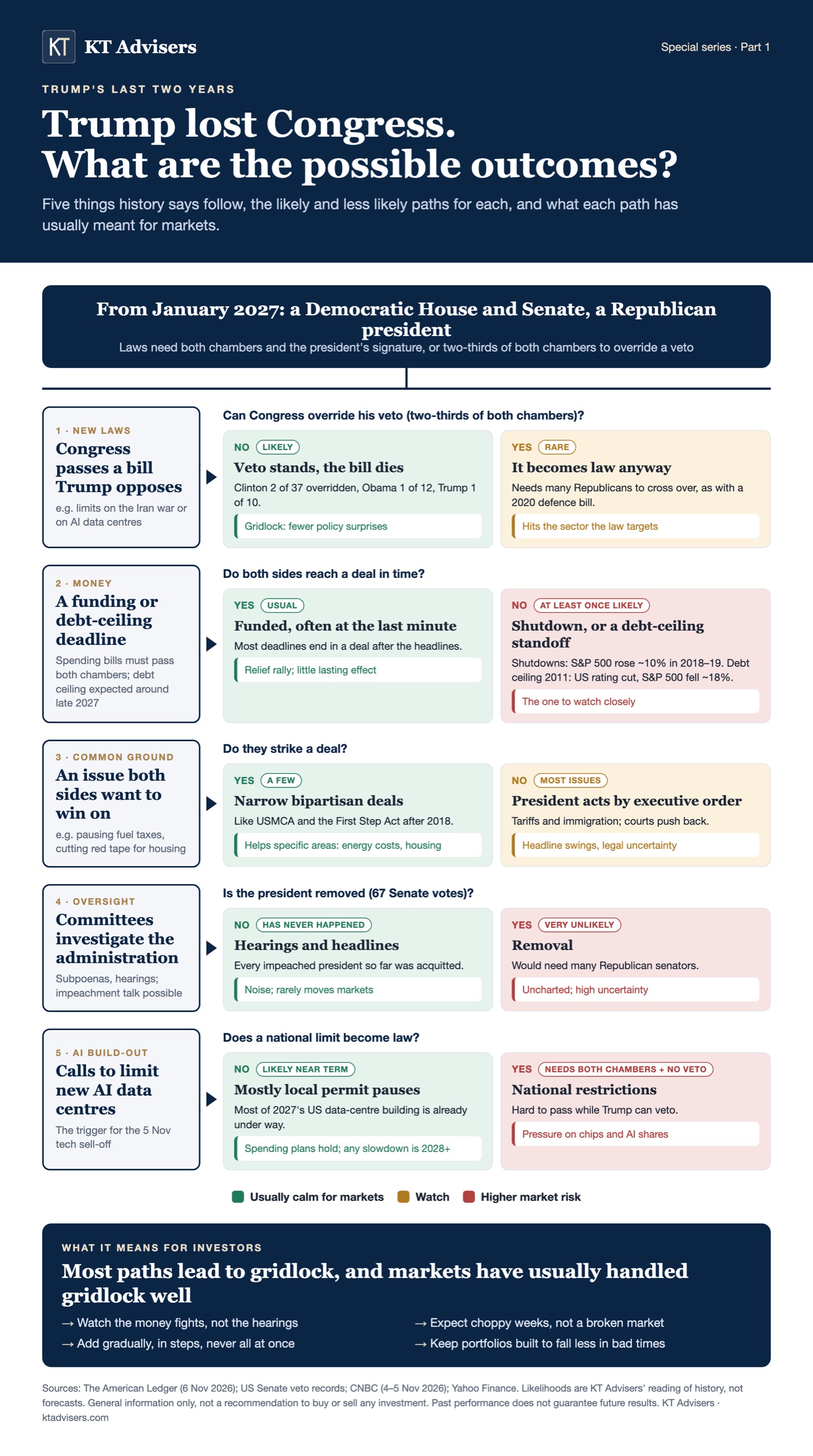
This has happened before. Truman (1946), Eisenhower (1954), Reagan (1986), Clinton (1994), Bush (2006) and Obama (2010 and 2014) all lost control of Congress during their presidency, and Trump lost the House in 2018. History gives us a good guide to what comes next.
The pattern
Five things that almost always follow
1 · The veto becomes the president's main tool
Overriding a veto needs two-thirds of both chambers, which is rarely reached. Clinton vetoed 37 bills and only 2 were overridden; George W. Bush 12 (4 overridden); Obama 12 (1); Trump in his first term 10 (1). Democrats will not have two-thirds this time either, so most bills the president opposes will simply stop at his desk.
Why markets careFewer new laws means fewer policy surprises. Big changes become harder in both directions.
2 · Funding fights, and the risk of shutdowns
Every spending bill has to pass both chambers, so this is where divided government fights hardest. Clinton faced shutdowns of 5 and 21 days in 1995–96; Obama a debt-ceiling standoff in 2011 and a 16-day shutdown in 2013; Trump a 35-day shutdown in 2018–19. Expect at least one major funding standoff in the next two years.
Why markets careShutdowns make headlines but have rarely done lasting damage: the S&P 500 rose about 10% during the 2018–19 shutdown. The debt ceiling is different. In 2011 the US credit rating was cut for the first time and the S&P 500 fell about 18% from late July to early October. The next debt-ceiling deadline is expected around late 2027.
3 · Investigations
The majority party runs the committees, so hearings and subpoenas follow: Iran-Contra under Reagan, years of inquiries under Clinton, two impeachments of Trump after 2018. Removing a president needs 67 Senate votes, which has never happened.
Why markets careLoud, but historically not a big driver of share prices.
4 · Fights over the courts
A Senate controlled by the other party can slow or block judges, as with Robert Bork in 1987 and Merrick Garland in 2016. If a Supreme Court seat opens, expect a long fight.
Why markets careLimited in the short term.
5 · The surprise: some deals still happen
Eisenhower and a Democratic Congress built the interstate highways (1956). Clinton signed welfare reform and a balanced-budget deal. Trump signed the USMCA trade deal and the First Step Act after losing the House in 2018. Deals tend to be narrow, on issues where both sides can claim a win. Early candidates this time: a pause in federal fuel taxes and cutting red tape for housing.
Why markets careNarrow deals can help specific areas (energy costs, housing). Where deals fail, presidents turn to executive orders, which the courts often challenge.
Our read
What it means for investors
- Gridlock has rarely been bad for markets. With fewer new laws, investors face fewer policy shocks. Widely cited market histories show the S&P 500 higher twelve months after every midterm election since the Second World War. That is a pattern, not a promise, but it helps keep a bad week in perspective.
- The data-centre worry is real but slow. Any national limit would need to pass both chambers and survive a veto. Most of next year's US data-centre building is already under way, so the near-term spending plans of the big technology companies are unlikely to change quickly.
- Watch the money fights, not the hearings. Funding deadlines and the debt ceiling are the political events most likely to move markets. We will flag them well ahead.
- Expect more volatility in the short run. The weeks after a US election are often choppy. We would rather add to good long-term holdings gradually, in steps, than react to any single day.
Our approach stays the same: watch and engage as things change, keep portfolios built to fall less in bad times, and never over-commit to one theme.
Coming up
What we'll watch, and the next parts of this series
- January 2027: the new Congress is sworn in, and the first funding deadlines follow.
- AI and data centres: whether calls for limits turn into actual bills, and how the technology companies respond.
- Tariffs and executive orders: how far the president goes alone, and how the courts respond.
- Late 2027: the next debt-ceiling deadline.
Sources: The American Ledger, "Trump Just Lost Congress | What History Says Happens Next" (6 Nov 2026) · CNBC, 4–5 Nov 2026 (midterm results, data-centre calls, debt-ceiling outlook) · US Senate, presidential vetoes record · Market data: Yahoo Finance, close of 5 Nov 2026