What happened
A four-day meeting about discipline, one year before the one that matters
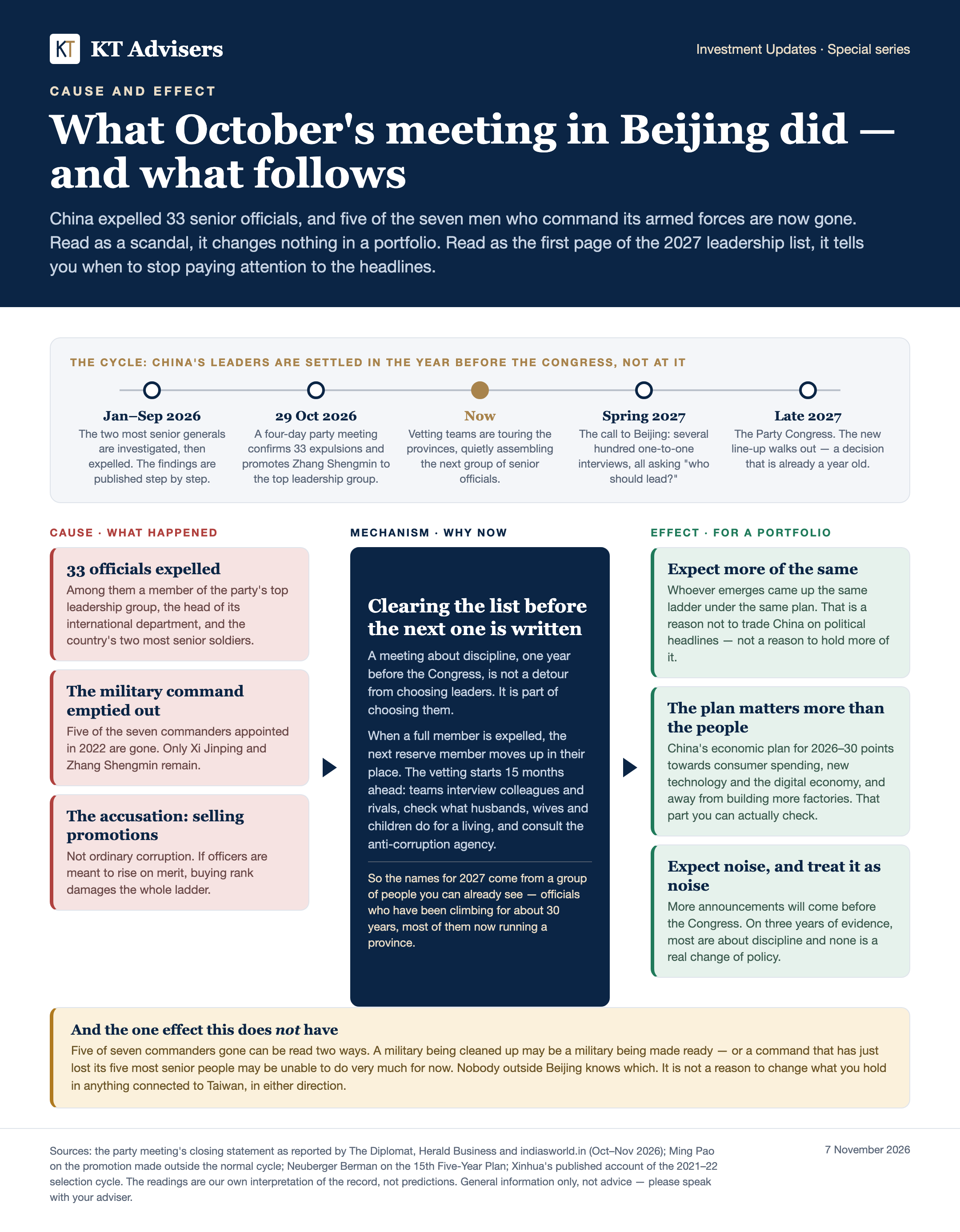
On 29 October a meeting of China's Central Committee closed in Beijing after four days. A word of explanation first, because the names are unfamiliar and they do matter. The Central Committee is a body of around 370 senior officials — the top layer of the Chinese Communist Party. When it gathers between its big five-yearly congresses, the meeting is called a plenum. There are usually seven of them in a cycle, and each one tends to have a theme.
This one had a single item on the agenda. Not the economy, not foreign policy, but discipline. It confirmed the expulsion from the party of 33 senior officials. Among them were the vice-chairman of the body that commands China's armed forces, the head of the military's joint staff, a sitting member of the Politburo — the two dozen or so people at the very top of the party — and the head of the party's international department.
The arithmetic is worth pausing on. The Central Military Commission, which commands China's armed forces, was formed in 2022 with seven members. Five of those seven have now been expelled. Two remain: Xi Jinping himself, and Zhang Shengmin, the commission's discipline chief, who was promoted at the same meeting. Attendance in the room was down by 36 people compared with the equivalent meeting a year earlier.
The same announcement confirmed that the Party Congress — the five-yearly gathering where China's next leadership is revealed — will be held in the second half of 2027, and that whether Xi takes a fourth term will be decided there.
Most of the Western coverage used one word: purge. That is not the part that matters to your money.
The detail worth noticing
One promotion, made in an unusual place
Zhang Shengmin was not simply promoted. He was added to the Politburo at a plenum rather than waiting for a Party Congress — and according to the Hong Kong newspaper Ming Pao, that had not happened since 1994.
That sounds like a technicality. It is not. Doing it out of the normal cycle, rather than waiting eleven months for the Congress, is the kind of procedural signal that is easy to miss and hard to explain away. It suggests the party wanted him in place now, and it makes it more likely he keeps the position in 2027. He is also now the only military figure in the Politburo apart from Xi himself.
Set against that, the name analysts most often raise as a possible successor — if power changes hands at all — is Ding Xuexiang, one of China's vice-premiers. The reasoning is partly simple arithmetic: he turns 65 in 2027, which sits comfortably inside the party's unwritten retirement convention, whereas Premier Li Qiang will be 68.
Two cautions, and we mean them. Xi has given no public signal that he intends to step down or name a successor, and the general expectation is that he will seek a fourth term. And this is analysts reading tea leaves, not an announcement — as the video that prompted this report puts it, any Western think tank claiming to know who gets those jobs is guessing. We repeat the names because they tell you where the market's attention will go, not because anybody knows.
Why it matters
The decision is made in the year before the Congress, not at it
This is the single useful idea for an investor, and it is the reason we are writing about a party meeting at all.
China's leadership is not actually chosen at the Congress. By the time a line-up walks out in front of the cameras, the decision is roughly a year old. We know how this works in some detail, because China's state news agency published an account of the last round.
Fifteen months before the 2022 Congress, 45 inspection teams were sent out to all 31 provinces and to 124 ministries, banks and state-owned companies, with eight more teams covering the military. They interviewed not only the candidates themselves but their colleagues, their juniors and their rivals. They checked what the candidates' husbands, wives and children did for a living. They consulted the anti-corruption agency more than a thousand times. And they went to physically look at the flood defences and the mines that officials had reported building.
Then, a few months before the Congress, came several hundred one-to-one interviews — more than 300 of them between April and July 2022, thirty of those conducted by Xi himself — each asking the same question, with no limit on how many names you could give: who should lead?
So the fact that matters today is not what October's announcement said about the people who fell. It is that the inspection teams for the 2027 line-up are out on the road right now, and that a meeting which clears names off the list is part of writing the next one.
An investor waiting for the Congress in late 2027 to find out who will set Chinese policy into the 2030s is, in a real sense, a year late. And the names will in any case come from a pool of people who are already visible: officials who have spent roughly three decades climbing, most of them currently running a province the size of a European country.
The honest limits
What this does and does not tell you about the risk of holding China
1 · The direction of policy is already written down
The personalities get the coverage. The policy sits in the Five-Year Plan — the document, published every five years, that sets out what the government intends the economy to do. The 15th plan runs from 2026 to 2030. It shifts the emphasis towards consumer spending and new technology, and away from the building-things-and-green-manufacturing push of the previous plan. It talks about "orderly competition" rather than unlimited production capacity — China's own term for stopping its companies from competing each other into losses. And, notably, it drops the old target for making all its own computer chips in favour of a broader measure of the digital economy.
What it means for youIf you hold China, this document tells you more about the next five years than any guess at who gets the top jobs in 2027. Holdings tied to consumer spending and technology sit with the plan. Holdings tied to heavy industry and raw materials sit against it.
2 · Continuity is the sensible starting assumption, not a prediction
Whoever emerges will have come up the same ladder, under the same plan, checked by the same machinery. That argues for the direction of policy staying broadly the same — which is a genuine difference from countries where policy can turn completely on a single election.
What it means for youTreat continuity as the reasonable default, and still size the holding so that being wrong would not hurt you badly. It is a reason not to trade China on political headlines. It is not a reason to hold more of it.
3 · The military story can be read two ways
Five of seven commanders gone is extraordinary by any standard, and there are two coherent readings. One: a military being cleaned up is a military being made ready, and the accusation in these cases was the selling of promotions, which eats away at a chain of command. Two: a command structure that has just lost five of its seven most senior people is, for now, less able to carry out anything ambitious.
What it means for youNobody outside Beijing knows which reading is right, ourselves included. It is not a reason to change how much you hold in anything connected to Taiwan, in either direction.
4 · The governance risk has not gone away
The same facts that show a system policing itself also show one where a sitting member of the Politburo and the country's most senior soldier can be removed without any independent process, and where the rules a listed company operates under can change by government decision. Both of those readings of the past three years are true at the same time.
What it means for youThis is why China belongs in a portfolio as a deliberately chosen amount with a worst case you have thought about — not as a big bet you feel strongly about.
What we are not saying
One deliberate omission
This report began with a video that spends its second half arguing that China's way of choosing leaders compares well with British and American democracy — six UK prime ministers in ten years, and presidents who have never held office before, against a thirty-year apprenticeship.
We have left that argument out, and you should know we did it on purpose. It is a political question rather than an investment one, and we are not the right people to settle it.
It also leans on a figure that needs handling carefully: a Harvard survey finding 93% satisfaction with China's central government. The survey is real. But the data dates from 2016, the fieldwork was done by a domestic polling firm, and it measures something that is difficult to ask about candidly in any one-party state.
What survives that filter is the part we have used above: the process is documented, the timing is knowable, and the direction of policy is written down in advance. Those are facts you can plan around, whatever you happen to think of the system that produces them.
What we are actually doing
Three checks before the 2027 cycle gets loud
- Find out what your China exposure actually is. Most Singapore portfolios hold China in three places at once — a dedicated China fund, a slice of any Asia-excluding-Japan or emerging-markets fund, and the sales that regional companies make into China. Added together, the total is usually larger than the one obvious line on the statement suggests.
- Line it up against the plan, not the politics. Consumer spending, home-grown technology and the digital economy are where the 15th Five-Year Plan points. If the reason you own something depends on the priorities of the previous plan, that is the conversation worth having.
- Expect noise through 2027, and decide now how you will treat it. There will be a steady run of announcements between here and the Congress. On the evidence of the past three years, most will be about discipline and none will be a genuine change of policy direction. Deciding in advance that this is background rather than a signal is worth more than reacting well to any single one of them.
And the thread back to our last report: the question that would really matter for Asian portfolios is not who stands where in the autumn of 2027. It is what happens at the Malacca and Taiwan Straits if relations break down. A leadership list does not resolve that risk, and an announcement from a party meeting does not price it.
Sources: Harvey on China, "China Just Picked Its New Leaders - and No One Realised" (26 Oct 2026) — the video this report began from, published before the plenum closed · The Diplomat, "What China's Half-Empty 5th Plenum Says About Its Next Leaders" (Nov 2026) · Herald Business, "China expels 33 senior officials from Communist Party, tightens discipline ahead of congress" · indiasworld.in, "Explainer: China's Fifth Plenum and Xi's Drive to Discipline the Party" · Neuberger Berman, "China's Blueprint: What the 15th Five-Year Plan Means for Global Investors" · Harvard Kennedy School Ash Center, "Long-term survey reveals Chinese government satisfaction" (2020, data to 2016) — cited in the video, treated with the caveats noted in the report · Xinhua's published account of the 2021–22 selection cycle, as described in the video